Most people are pretty happy to finish up with high school. No more exams, assignments or using school toilets (which are a public toilet’s poor man’s toilet). Of course, there are some things to be missed. Like the daily, after-school consumption of chicken-salted chips. My body still hasn’t adjusted to the lack of chicken salt that came in the years after high school. I am constantly licking the sweat off my own forearms in an attempt to relive the salty, halcyon days of my youth.

There are plenty of good books on English syllabi that should be missed upon leaving high school too. And yet they are not for the simple fact that during school they are endlessly discussed, dissected, analysed, read, reread, never-read, dictated, performed and ultimately used as a measuring stick of language and literacy skills. Doesn’t that sound like fun? No, maybe it doesn’t. It’s certainly not the way I enjoy books these days.
There’s no getting around the fact that to study a text you need to know it inside out and do all the dissecting, etc well. And occasionally you’ll find a book that is so good it outweighs the amount of in-class scrutiny. But there is now another way to study books on the English syllabus, which is fun and insightful. I’m speaking [shameless self-promotion alert, eek!] about the Wheeler Centre’s Texts in the City series, which this year I am co-hosting.
Every week at Texts in the City a different book from the VCE English syllabus is selected and an expert is invited along to talk about it. Every week either myself or the delightful Ruby J Murray host the conversation with that guest. One week Ruby hosts, the next week I do and so on. The Wheeler Centre is like a shared beach house that we take turns at visiting on Tuesday afternoons.
We’re only a few weeks into this year’s program but I’ve already been wowed by the weekly turnouts (mostly VCE students, but some other interested folk too) and the thoughtful questions that have come so far in the Q&As following the sessions. It’s amazing how good the audience questions are when they really want an incisive answer. Each session is free but they book out quickly so get thee to the Wheeler Centre and book yourself — or your class — in now.
Next week author Benjamin Law joins me to discuss Growing Up Asian In Australia, the anthology edited by Alice Pung a couple of years back. Mr Law, of course, has a couple of pieces in the book and will no doubt be talking about them, while simultaneously being funny/charming/rude/etc. More info and booking deets here.
In the coming weeks we’re looking at a range of texts including Ransom by David Malouf, The Quiet American by Graham Green, A Streetcar Named Desire by Tennessee Williams, The Rugmaker of Mazar-e-Sharif by Robert Hillman and Najaf Mazari and Cosi by Louis Nowra.
Hopefully these sessions will help make the texts last beyond high school for the attending students. To the point that they read in the future, the same way I lick my arms for salt now.
Having a blog is hard. You have to, like, remember to blog and stuff. How awful it that! The only thing more awful is when bloggers don’t post for ages and then come back and blog about how they haven’t been blogging.
And while it can be a bit lamo, this kind of post is understandable. Returning to one’s blog after a long absence is like crawling out of a hole in the ground, all squinty-eyed after a long underground sabbatical. So to avoid boring you any longer with my I’m blogging again blog post, here are some photos of animals emerging from holes. It’s quite a stirring tribute to the concept of blogger rebirth, if I do say so myself.
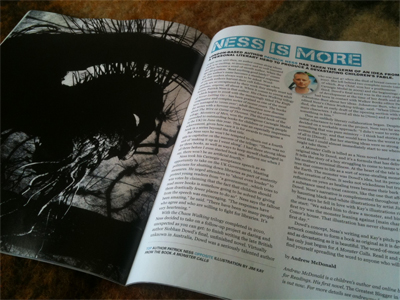
Hi all, just a quick note to let you know that the books pages of the current issue of The Big Issue — the independent Australian magazine sold by friendly vendors all over the place (and hopefully near you) — are guest edited by yours truly.
Coinciding with Book Week this week, there is a heavy focus on children’s and Young Adult literature in the issue including:
* An interview with Patrick Ness, author of A Monster Calls and the Chaos Walking series
* A column by Melina Marchetta on YA subject matter, gatekeepers and that WSJ article
* Lili Wikinson reviews Karen Healy’s YA novel The Shattering
* Holly Harper reviews this year’s highly-paid middle fiction novel The Emerald Atlas
* I review Mandy Ord’s collection of graphic stories Sensitive Creatures
* And I talk up Book Week and lament the fact it’s not a bigger media event in Australia
I think it’s awesome that The Big Issue gives over so many of its pages to kids’ and YA books during Book Week, so do grab a copy (with poor old Amy on the front cover) if you see one when you’re out and about this week.
I was watching a news report of 96-year old artist Dickie Minyintiri winning the National Aboriginal and Torres Strait Island Art Award last week and couldn’t help but gawk wide-eyed when the cameras showed us his and a handful of other artworks that had been nominated for the prize. They’re currently on display at the Museum and Art Gallery of the Northern Territory and you can view them online too – it’s worth taking a few moments to browse through. They’re beautiful, striking pieces of art and I remember sitting there thinking, I have no idea how the judges settled on one piece of art when each looks to be its own unique and wondrous beast.
And I realised I’d done exactly that myself only a month or so ago when I judged the Young Adult category of the Victorian Premier’s Literary Awards. No doubt judging indigenous art seemed like a herculean task to me because I don’t have the same experience and cultural reference points that I do for teen literature, although Australian YA also had its fair share of unique and wondrous beasts published over the past year.
The actual judging of the Vic Premier’s awards with Mike Shuttleworth and Leesa Lambert of The Little Bookroom was a blast. With so many books to discuss, each meeting we had was like taking part in a book club on steroids. There were opinions flying everywhere, books being waved passionately about in the air and a truckload of fun being had (by me anyway, who knows what Mike and Leesa thought of all my opinions and book waving).
One of the most pleasant things about judging the awards was reading each of the 70 or so books we were sent and for each one thinking: Yep, I can see who the reader of this book would be. It’s for adventurous boys with a sensitive side, it’s for slightly withdrawn girls aged 13–15, it’s for ‘class clowns’ at around 14 years, etc. Not that matching a perceived audience to a book is part of the judging process, and maybe it’s the tiny bit of bookseller inside me, but I found it comforting as I read through the books to match each one up with a reader in my mind.
I read a lot of teen fiction over the course of two months and got a pretty good idea of the spread of YA publishing in Australia at the moment. It was particularly cool to see the rise of the urban fantasy novel, as noted in our judges’ observations, where we were also able to name drop some novels that didn’t make the shortlist, namely Lili Wikinson’s A Pocketful of Eyes, Marianne de Pierre’s Burn Bright, Scot Gardner’s The Dead I Know, Rebecca Lim’s Mercy, Rebecca Burton’s Beyond Evie, Leanne Hall’s This Is Shyness, Ursula Dubosarsky’s The Golden Day and Laura Buzo’s Good Oil. Hooray for all of these books. They deserve to be borrowed from libraries, written on shopping lists and marked as ‘to-read’ on bookwormy social networking sites.
But of course the biggest to-dos must be saved for the three books on the shortlist: The Life of a Teenage Body-Snatcher by Doug McLeod, The Three Loves of Persimmon by Cassandra Golds and Graffiti Moon by Cath Crowley. Three highly original novels, each more than worthy of winning the overall YA award. I’ll be at the awards dinner next month, cheering all three of them on – even though I already know who wins.